

The Prime Minister’s time is one of the state’s scarcest governance resources — a resource of government that cannot be expanded or replaced. In an age when economics and security have become inseparable, and when the questions of which countries to align with and which sectors to commit public funds to converge on the head of government, the weight of the work only the Prime Minister can do — conceiving and deciding major policy, conducting summit diplomacy — has grown accordingly. Looking ahead to the changes the international environment will bring, it is important to review the arrangements that support the Prime Minister’s time rather than leave them bound by conventional practice.
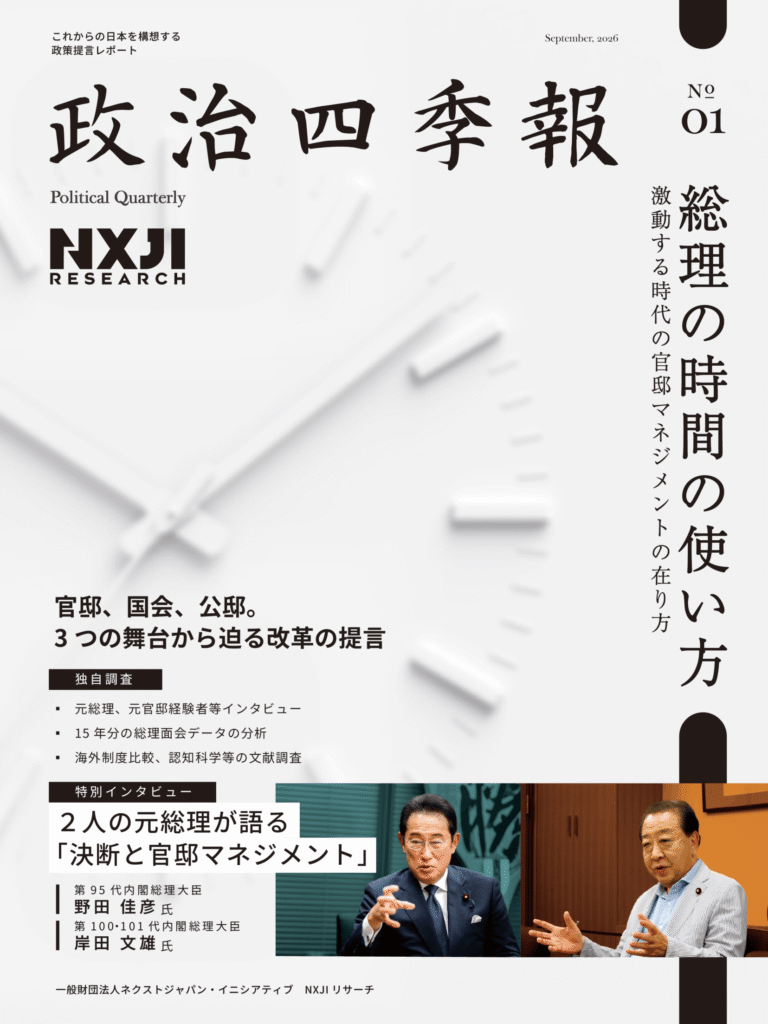
This report brings together interviews with former Prime Ministers and former officials of the Prime Minister’s Office (the Kantei), along with research across a range of related fields. It analyzes the Prime Minister’s time from two perspectives — quality and quantity — and sets out five recommendations addressed to three settings: the Prime Minister’s Office, the Diet, and the Official Residence.
What the research revealed was a schedule of remarkable density: more than 2,000 recorded meetings a year; the handling of Diet business across sessions that run to some 200 days a year; and, on top of that, the conduct of daily life and the management of one’s own health at the Official Residence. It revealed, too, an Office whose operation rests heavily on the capacity of exceptional and resilient individuals — a team that must make a running start with no preparation period and then keep running day after day, while the Prime Minister judges, case by case, how to carve out the input and the needed rest.
To maximize the value of the work only the Prime Minister can do, an optimal team should be assembled around the Prime Minister; the policies and the practical know-how that sharpen the Prime Minister’s judgment should be accumulated and handed on; answering in the Diet should in principle be consolidated into the Party Leaders’ Debate — the Diet’s leader-to-leader question session, and an institution distinct from the United Kingdom’s Prime Minister’s Questions — so as to give the Prime Minister greater freedom of maneuver for major policy decisions and summit diplomacy; and the Official Residence should be equipped to support the Prime Minister’s sleep and nutrition.
We hope that this research and these recommendations will contribute to the discussion and deliberation ahead on how the Prime Minister’s time can be put to better use in the national interest.
The issues
Issues in the quality of the Prime Minister’s time
- The Prime Minister’s judgment — Input and time alone are limited, and the sheer volume of matters to be decided erodes the quality of judgment.
- The Prime Minister’s team — With no criteria for appointments and no period in which to prepare, the team in the Prime Minister’s Office that supports that time cannot be brought to its full strength.
Issues in the quantity of the Prime Minister’s time
- Time at the Prime Minister’s Office — Beyond the sheer number of meetings, more than 2,000 a year, the Prime Minister’s time is also consumed by meetings that are not essential.
- Time in the Diet — Handling Diet business across sessions that run to roughly 200 days a year, on a calendar that remains uncertain until the last moment, squeezes diplomacy and other work.
- Time at the Official Residence — The Prime Minister’s own time is taken up by the upkeep of daily life, and neither nutrition nor sleep receives proper attention.
The recommendations
Recommendation 1 | The Prime Minister’s Office — Refine and filter the matters the Prime Minister should personally handle, and place the resulting criteria for schedule management, together with the practical know-how of logistics, on an institutional footing so that they pass from one administration to the next.
Recommendation 2 | The Prime Minister’s Office — Create a period of preparation before the designation of the Prime Minister, and strengthen the management arrangements of the Office through appointments built around the Principal Executive Secretary to the Prime Minister — the senior-most of the Prime Minister’s executive secretaries and a political appointee — so that the management of matters and of the schedule becomes effective in practice.
Recommendation 3 | The Diet — As a rule, the Prime Minister’s attendance at committees, including the Committee on Budget, should not be required.
Recommendation 4 | The Diet — Consolidate the Prime Minister’s answering in the Diet into the Party Leaders’ Debate, so that the time at the Prime Minister’s own disposal becomes more predictable.
Recommendation 5 | The Official Residence — Introduce nutrition management and domestic support at the Official Residence, such as a chef and housekeeping staff, so that the Prime Minister can concentrate on official duties.
Alongside interviews with former Prime Ministers and former officials of the Prime Minister’s Office, this study analyzed meeting data and reviewed a wide range of literature. The issues and the recommendations draw these strands together; for details, see the relevant chapters of the main report.
Analysis of meeting data. Even within the limits of what the public record shows, many past Prime Ministers have held more than 2,000 meetings a year. Meetings to receive policy proposals and requests from the ruling party, and meetings with companies and industry associations, have been trending upward, and courtesy calls and visits for tourism promotion are more numerous than they were before the COVID-19 pandemic.
Findings from neuroscience and sleep medicine. Chronic insufficient sleep degrades attention, and the number of matters requiring a decision is itself a cause of declining performance. Alongside adequate sleep, exercise and rest, it matters to find ways of reducing the number of low-stakes decisions.
Time-management arrangements in other countries. In the United Kingdom, the Prime Minister’s accountability to Parliament is concentrated in Prime Minister’s Questions — roughly 30 sessions of 30 minutes each a year. In Germany, after successive revisions of the rules, the Chancellor now takes questions from the Bundestag in three 60-minute slots a year. The United States, as a presidential system, differs; but at the White House the discipline of protecting the President’s time is handed down from one administration to the next, and a dedicated office supports the management of meetings and of the schedule.
This study also included special interviews with Yoshihiko Noda, the 95th Prime Minister, and Fumio Kishida, the 100th and 101st Prime Minister, who looked back on how the Prime Minister’s time was used during their own administrations. These are published as special interviews.